
Prime Minister's change in approach will have chilling effect on investment聽


Simon McWhirter, UKGBC’s Deputy Chief Executive said:
The anger and frustration at this latest policy U-turn has reverberated across industry today. Delaying green policies just means they鈥檒l have to be implemented much faster, later, pushing up the cost for everyone – householders and businesses alike. The Prime Minister鈥檚 change in approach will also have a chilling effect on investment and skills training across green industries as they鈥檙e faced with yet another pull on the policy handbrake, just as our members and wider business were scaling up their pro-green activities across the economy.
To really tackle this problem, the best way to bring down costs for households is to insulate homes, but the Prime Minister pulled the plug on measures to ensure landlords upgrade the draughty homes of renters – the group most affected by fuel poverty. Apart from an increase in the heat pump grant, no other measures were announced to incentivise and help households to insulate and make the transition from fossil fuel heating. We鈥檙e awaiting the long-overdue national strategy to upgrade all of our homes and buildings. But all we鈥檝e had today is a further erosion of commitment and clarity from government鈥�
UKGBC’s members stand united as the voice of the built environment
A number of UKGBC members have similarly responded to the Prime Minister’s announcements, demonstrating the strong appetite for robust net zero policy amongst the UK’s business community.
Kaela Fenn-Smith, Manging Director, Sustainability & ESG Consultancy, CBRE UK and Ireland, said:
I want to encourage the Prime Minister not to row back on all the hard work so many of us have invested in moving the UK towards a safer, secure, sustainable future.
With the business community coming together like never before to drive climate action, we need clarity and certainty.
Amidst a cost-of-living crisis that鈥檚 left millions struggling, we urgently need to recognise that protecting the environment doesn鈥檛 need to come at the expense of hard-working families.
As someone passionate about economic prosperity, jobs and growth, any backwards shift in policy represents a damaging step and potentially undermines the very future of our economy and life on this planet.
Emma Hoskyn, UK Head of Sustainability at JLL, said:
Today鈥檚 announcements on the government’s net zero position will be disappointing to many businesses that, like JLL, are advocating for ambitious climate action, such as through alignment with the UN Race to Zero.
It is through robust net zero policies and a stable landscape that the real estate sector, from investors to occupiers, can have confidence in, and capitalise on, the opportunities that a rapid transition to net zero can provide. We commend the ambition to speed up the planning process for national energy infrastructure to support that transition.
However, rolling back on net zero commitments will destabilise investment into green skills, sustainable technology and energy efficient homes. It will also derail the opportunities and security that a green economy and green energy can provide for the UK, for business and for individuals.
At JLL, we will continue to work with sector partners such as 糖心视频, Aldersgate Group, Business in The Community, WWF, Cambridge Institute for Sustainable Leadership and the British Property Federation to ensure a rapid and just transition to a net-zero, climate resilient, nature-positive future, calling on the government to provide the commitment and policy to support businesses and households in this transition.”
Tor Burrows, Group Sustainability Director, Grosvenor
Diluting the UK鈥檚 commitment to net zero is not the way to build our economy, create jobs or address climate change.
Businesses desperately need clarity and stability to help them plan how they will invest in green practices, tech and skills. Without this we risk losing out on crucial investment which will ease the cost of living and increase the country鈥檚 global reputation and competitiveness.
Changing course and pursuing a tactical agenda sends all the wrong signals and risks the many benefits an ambitious and essential climate agenda could bring people, the country and the planet.鈥�
James Hardy, UK Director, Sustainability, Turner & Townsend
Our industry, like many others, has been scaling up at pace to meet the government鈥檚 previously ambitious commitments around electric vehicles, energy efficiency and gas boiler phase-outs. As these contribute to the delivery of UK鈥檚 2050 statutory target, they aren鈥檛 a nice to have 鈥� they represent an absolute requirement if we are to mitigate the impacts of climate change.
The Prime Minister has rightly highlighted the importance of ensuring that those on the lowest incomes aren鈥檛 hardest hit by the transition to net zero. But by dialing down on action yesterday will cost us more in the long run as we have to respond to climate related disruption to food, energy and water supplies. There is readily available capital for green investment globally and delaying our net zero efforts risks making this capital more expensive too.
In addition, yesterday鈥檚 statement, coupled with the government鈥檚 recent offshore wind auction that failed to attract any bids – an industry in which UK is world leader – only deepens concerns for the UK鈥檚 net-zero aspirations. The roll-out of retrofit for homes and workplaces, EV charging networks and clean energy solutions are highly complex and do require the 鈥榣ong-term green thinking鈥� the Prime Minister called for 鈥� a programmatic approach with full and consistent support of government and industry is essential to success.
However, it must not be compromised by short-term political gain which could derail the years of long-term planning, delivery and progress that we are already working towards.”
Robin Peters, CEO of home energy efficiency platform Snugg, said:
Pushing back the phasing-out of fossil-fuel boilers will likely discourage people from taking up the offer of a more generous grant now. Increasing the grants for heat pumps is certainly good news, however 拢7,500 will still fall short of the full cost of installation for many households.
鈥淧eople living in older houses, in particular, will likely need additional insultation, double glazing if not already installed, and new radiators if the ones they have are too small. This can often exceed 拢15,000 鈥� double the new grant amount.
鈥淚t also does not address the fact that heat pumps on their own do not save consumers on their bills 鈥� homeowners will continue to be stuck with high ongoing costs. To cut costs, heat pumps need to be part of a complete system that includes solar panels and battery walls so that consumers can generate and store the electricity needed to operate them.鈥�
Becky Lane, CEO, Furbnow:
The policy changes announced are completely wrong for the UK and the planet. We shouldn鈥檛 be removing the commitments we’ve made and delaying by a decade the change we need now.
鈥淭his walk-back will mean that the preparations made by incumbents and new entrants in the Net Zero transition will be undermined and the potential for economic growth, and new jobs, in the green sector will be significantly impacted.
鈥淚f we know that in the next 10 years, we will have to hit targets, the sector will need to move forward now to get things in place, therefore bringing new tech, new jobs and seedlings of change now.
鈥淲ith this change of heart, the UK will no longer be an international green leader on the global stage. This decision has the potential to hamstring investment in the UK and investors will take their money elsewhere. We are already seeing this happen. In Europe alone, the acceptance of the climate crisis and willingness by regulators, businesses and consumers to take action make it a far-appealing investment opportunity.
鈥淭his Government’s decision is a short-sighted view with an election in mind鈥� It won鈥檛 save voters money in the long run and will damage our economy further鈥�.
Chris Hardman, Founder, PropEco:
This announcement is disappointing, although not entirely surprising.
While it is true that many green building upgrades can be costly, this will never change as long as an uncertain and unsupportive regulatory environment hinders innovation.
The impacts of climate change can鈥檛 simply be postponed, and fortunately many households and organisations recognise that delaying efforts to boost building efficiency and resilience will only prove more costly in the long-run.”
Home Retrofit

Policy & Advocacy
Related
UKGBC Trends Report signals growing focus on resilience across the built environment


Strong Taskforce recommendations for decarbonising Scottish homes should shape ambitious policy commitments聽


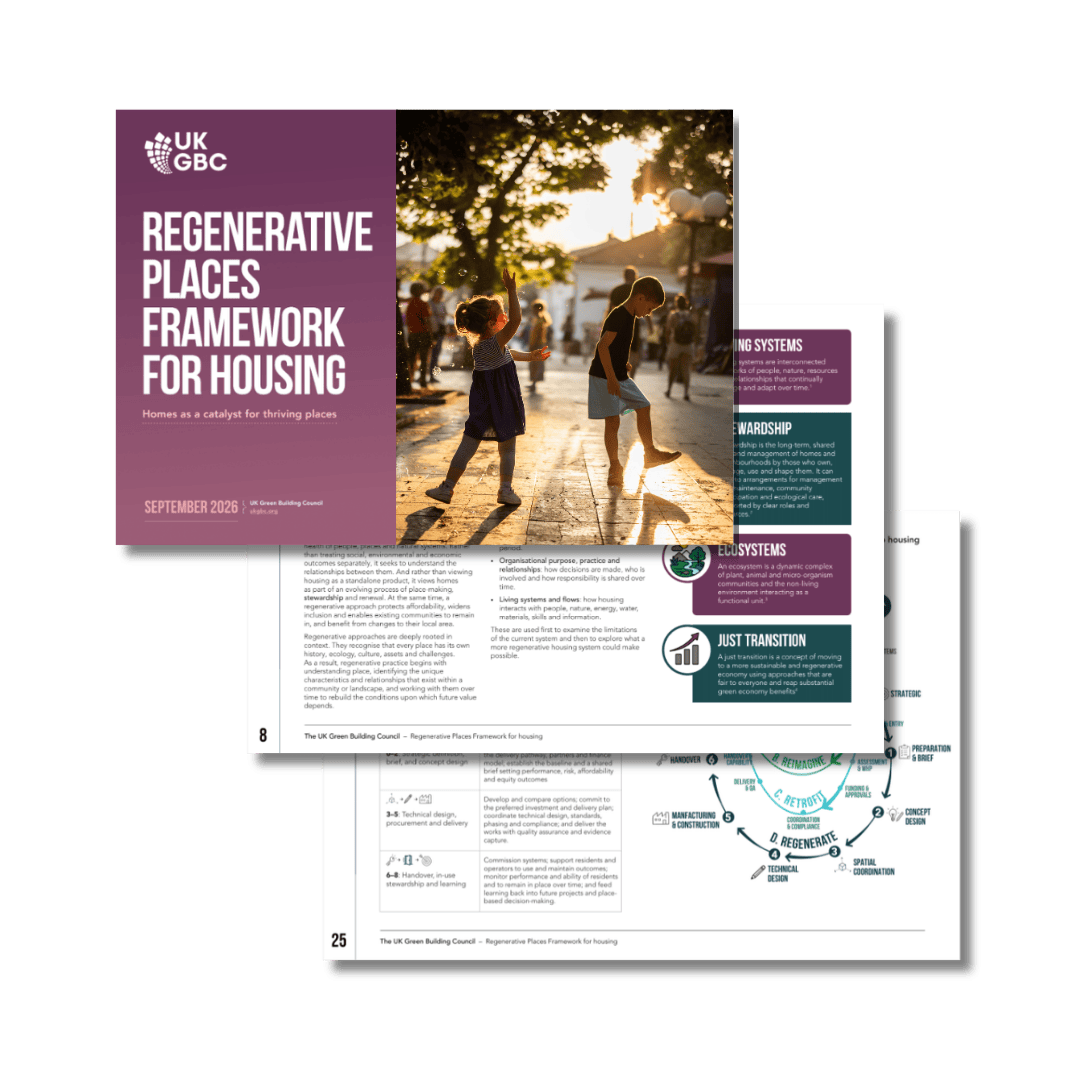
UKGBC launches Regenerative Places Framework for Housing

New Term, Fresh Start: What we need from the new government鈥檚 first year

